
Trieur Block (AZTB-07.800)
Technical specifications
| Model | Capacity\n[t/h] | Machine mass with full set of working units [kg] | Width [mm] | Length [mm] | Height [mm] | Total installed power [kW] |
|---|---|---|---|---|---|---|
| 07.800 | 5–8 | 1400 | 1080 | 3700 | 2650 | 4,4 |
| 07.800 (cylindrical cockle separator) | 5–8 | 700 | 1080 | 3195 | 1370 | 2,2 |
| 07.800 (cylindrical wild-oat separator) | 5–8 | 700 | 1080 | 3195 | 1370 | 2,2 |
Trieur surface selection table
| Crop being processed | Short impurities (cockle), mm | Long impurities (wild oat), mm |
|---|---|---|
| Wheat | 5,0 | 8,5; 9,5 |
| Rye | 5,0; 6,3 | 8,5; 9,5 |
| Barley | 5,0; 6,3 | 11,2 |
| Oats | 8,5; 9,5 | |
| Rice | 6,3 | 11,2 |
| Corn | 6,3 | 9,5 |
| Sugar beet | 9,5; 11,2 | |
| Flax | 3,6 | 5,0 |
| Mustard | 2,8 | 5,0 |
| Red clover | 1,8 | 2,5; 2,8 |
| Alfalfa | 1,8 | 2,5; 2,8 |
| Camelina | 1,8 | 2,8 |
Main parameters and characteristics
| AZTB 07.800 | |
|---|---|
| Type | stationary |
| Drive | electric |
| Supply voltage, V | AC, 380 V at 50 Hz |
| Operating scheme | series / parallel |
| Specific electricity consumption for wheat seed cleaning [kWh/t], max. | 0,80 |
Machine working-unit characteristics
| AZTB 07.800 | |
|---|---|
| Number of trieur cylinders for separating impurities (cockle / wild oat), pcs. | 2 |
| Number of trieur cylinder segments, pcs. | 4 (8) |
| Cylinder length, mm | 2300±5 |
| Internal cylinder diameter, mm | 800±3 |
| Trieur cylinder speed, rpm | 40±1 |
| Cell diameter for separating impurities from wheat, mm | 4 |
| Long impurities | 9,5 |
| Short impurities | 5,0 |
Process quality indicators
| AZTB 07.800 | |
|---|---|
| Seed category according to GOST R 52325, not lower than | ES, RS, RSt |
| Completeness of impurity separation, [%] min. | 0,8 |
| Content of main-crop seeds in waste [%] max. | 3 |
| Seed breakage [%] max. | 0,08 |
| Seed purity [%] min.: corn, sunflower | 98 |
| Seed purity [%] min.: wheat, peas, rice, rye, barley, oats, buckwheat, millet | 97 |
| Seed purity [%] min.: rapeseed | 96 |
| Loss of main-crop seeds with utilized waste [%] max. | 4,0 |
| Hard-to-separate impurities and dehulled grain: rice | 3,0 |
| Hard-to-separate impurities and dehulled grain: peas | 1,0 |
| Hard-to-separate impurities and dehulled grain: buckwheat, oats | 5,0 |
| Hard-to-separate impurities and dehulled grain: millet | 10,0 |
| Weed seed content [pcs/kg] max.: peas | 5 |
| Weed seed content [pcs/kg] max.: buckwheat | 80 |
| Weed seed content [pcs/kg] max.: fiber flax | 1700 |
| Weed seed content [pcs/kg] max.: rapeseed | 320 |
| Weed seed content [pcs/kg] max.: millet | 150 |
| Weed seed content [pcs/kg] max.: wheat, rye, barley, oats | 70 |
| Weed seed content [pcs/kg] max.: rice | 100 |
| Weed seed content [pcs/kg] max.: sunflower | 5 |
| Air leakage of seeds and impurities | not permitted |
| Process reliability coefficient, min. | 0,99 |
| Mean operating time to failure [h], min. | 200 |
Description
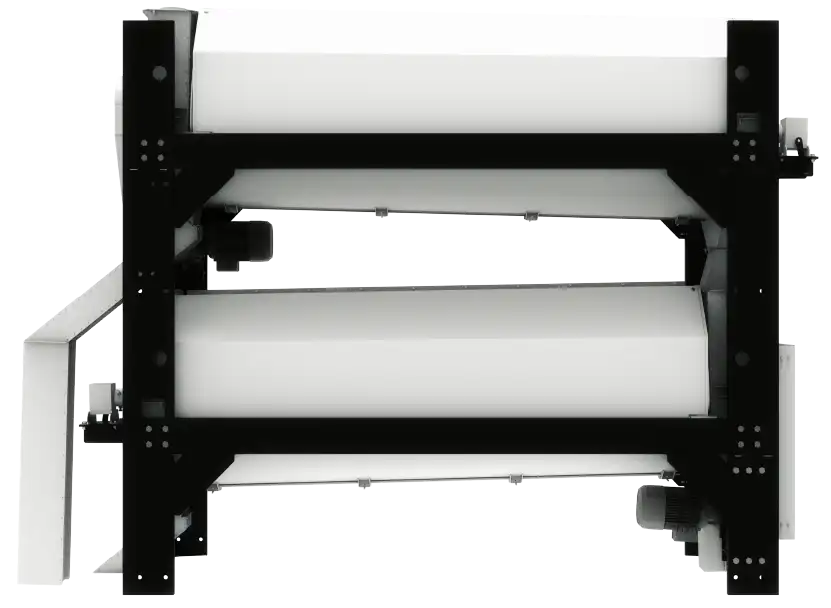
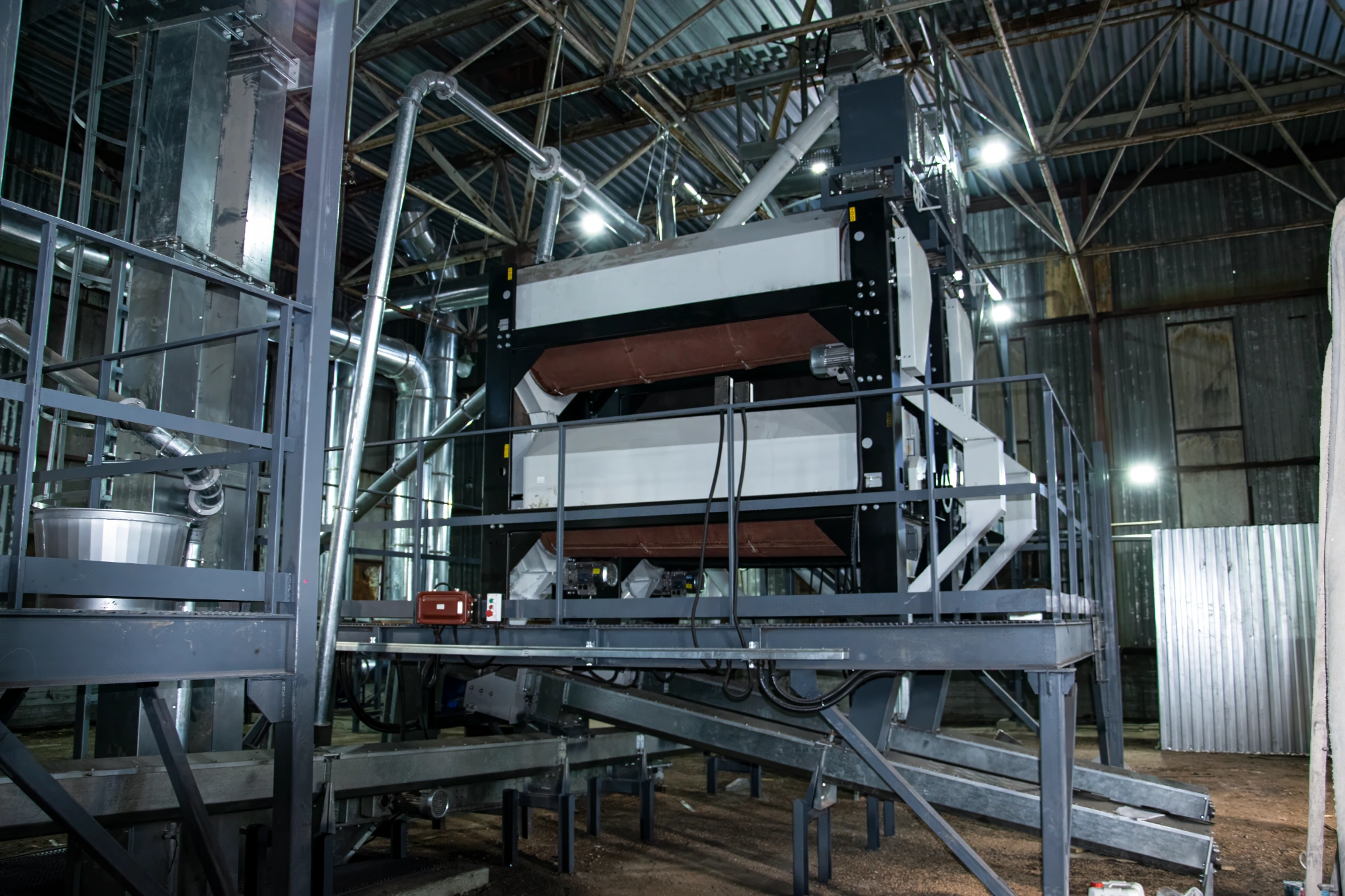
The trieur block is designed to clean food and seed grain from short (cockle) and long (wild oat) impurities. AZTB 07.800 is also used at grain-processing plants to separate dehulling products of some large crops.
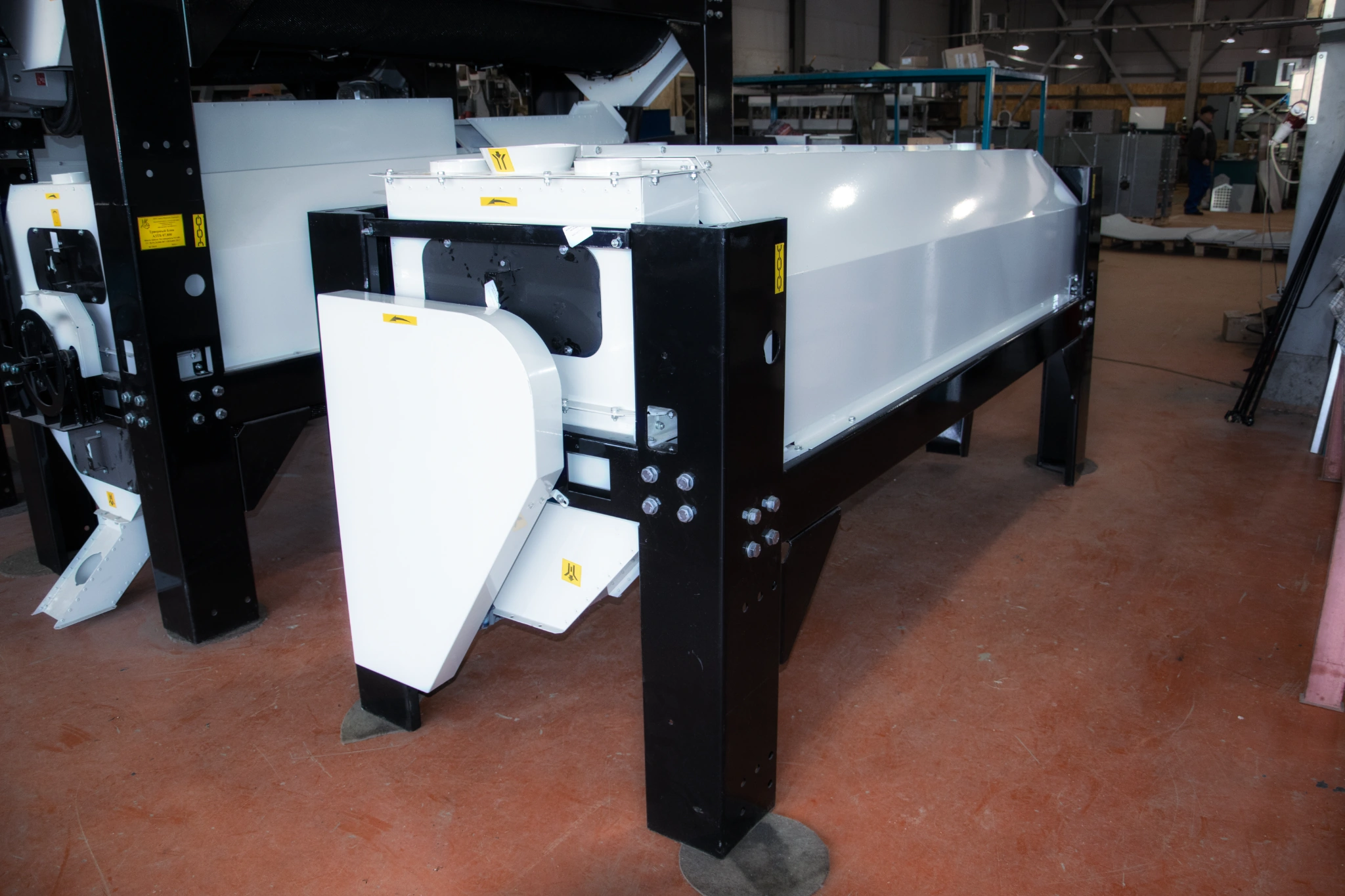
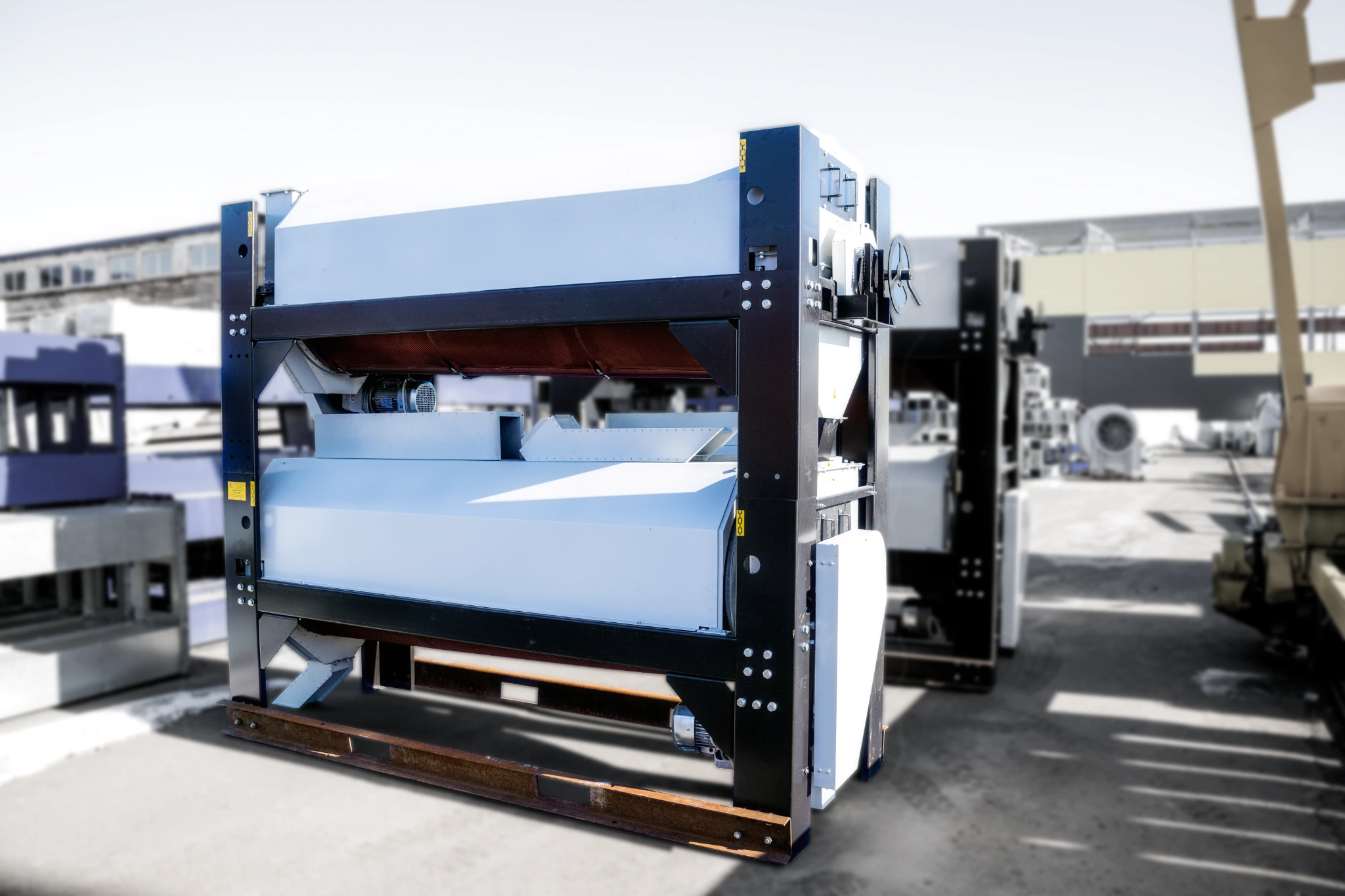
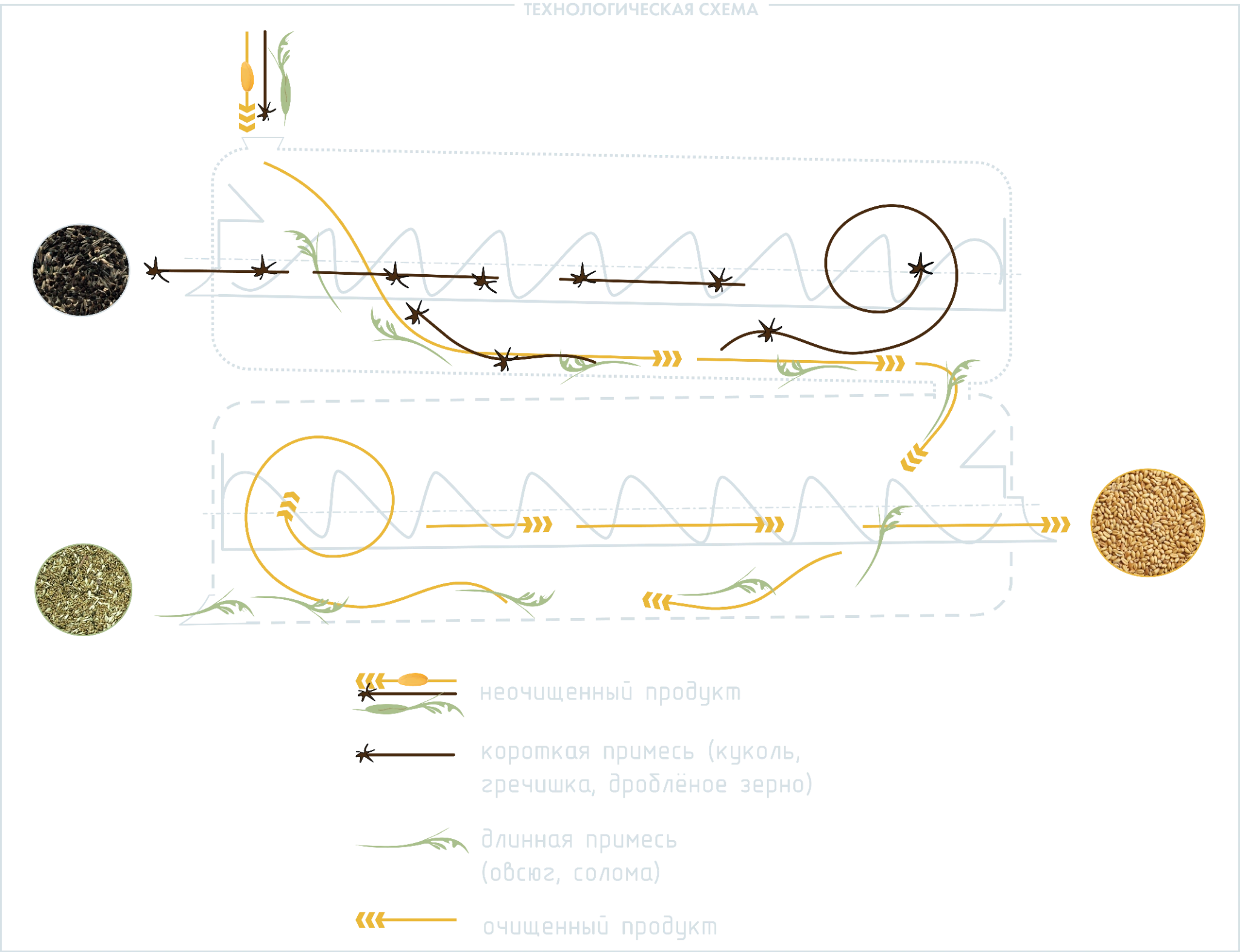
AZTB 07.800 trieur blocks consist of two trieurs arranged one above the other: a lower wild-oat trieur AZTB 07.800-O and an upper cockle trieur AZTB 07.800-K, each with an independent drive.
The upper AZTB 07.800-K trieur is rotated 180° relative to the lower AZTB 07.800-O so that the material outlet connects to the lower trieur receiver cover and is covered with canvas to prevent grain spillage. This arrangement allows sequential cleaning: short impurities are removed first, followed by long impurities.
Receiving chamber:
a flow divider for uniform aspiration and feeding of the product into the cylinder; made with detachable connections; has felt sealing at the cylinder contact points; standard d=200 mm connection; connection pipes for aspiration.
Working cylinder:
made of 3 or 4 segments; available with different cell sizes for different crops.
Tray:
reinforced to form a precisely level working edge; flow stabilizers along the outer edge ensure uniform product movement along the cylinder; an integrated screw conveyor removes product from the tray.
Discharge outlet:
welded into a steel structure; has a fixed side height through which product leaves the cylinder.
Material is fed onto the cell surface of the rotating cockle cylinder. Short impurities that enter the cells are lifted by the cylinder and discharged into the tray, then conveyed by a screw to the cockle separator receiver. Material containing long impurities that do not enter the cells is fed to the rotating wild-oat cylinder. Main-crop grains enter the cells, are lifted, discharged into the tray and conveyed by a screw to the wild-oat separator receiver. Long impurities that do not enter the cells leave the cylinder by gravity into the rear receiver. Long and short impurities are directed to the waste hopper, while cleaned material goes to the clean-grain hopper or to further cleaning.
The operating principle is based on separating the sorted material by length. A trieur-surface cell is used for this purpose; in plan it is circular and in cross-section it has the shape of a rectangular trapezoid with an inclined front wall, vertical rear wall and bottom. The trieur block cell is available in several sizes with different diameters and heights. Cell dimensions are defined by TU 23.21216-89. The table shows the selection of trieur surfaces by cell diameter depending on the crop being processed. The cell segments are installed so that, as the trieur cylinder rotates, the inclined front wall engages the material to facilitate entry into the cell, while the rear vertical wall ejects the material into the tray. With reverse rotation, material is not discharged into the tray and the process does not take place. Separation completeness depends on the position of the tray working edge. It must be set at the beginning of the zone where material leaves the cell.
Advantages
- Unified trieurs: interchangeable segments and an additional diaphragm are used when separating long impurities.
- The drive is equipped with a soft-start system, preventing fraction mixing and discharge into the tray during stopping and starting; it also improves the reliability of the geared motor.
- When switching to another cell size, the cylinders do not need to be dismantled; only the required segments need to be replaced.
- Supplied with interchangeable trieur surfaces for wheat (cell Ø 5.0 and 9.5 mm); optionally, surfaces for other crops according to the customer’s specification.
- Safe access for sampling.
Design
Submit an inquiry
Trieur Block (AZTB-07.800)